1.3.0 has two halves. Another long round of security fixes (sessions, tenants, storage), and then the fun half: you can see exactly what a user may do, and look at the app as them.
Two changes can stop a running app (/metrics and the observability :provider). They’re at the top of the upgrade notes below.
Security
29 entries in the changelog this time. The ones most likely to matter to you:
-
Sessions lived forever. A session slid to another 24 hours on every use and never ended (BOU-1007). It now ends after
:max-session-days(7), and the page asks before it does. A JWT kept working after logout, a password change or "Revoke all sessions" (BOU-1006). It ends with its session now. And a TOTP code could sign in twice within its 30 seconds (BOU-1016). -
Admins of one tenant reached into another. Several checks read a user’s role without looking at the tenant, so an admin in tenant A who was a plain member of tenant B passed admin checks in B (BOU-1020, BOU-1005, BOU-1010). A tenant admin could also change their own tenant’s status and limits, or delete it (BOU-1011), and take over a member of another tenant by changing their email and signing in through OIDC (BOU-1008).
-
Storage believed what it was told. A small PNG claiming to be 30000x30000 took 3.6 GB to decode (BOU-1085). An upload passed on its declared type and was served by its extension, so
x.exewent through asimage/png(BOU-1078). And the upload limits came from the query string (BOU-1076). -
The dev setup was too open. Any website you visited could run SQL on your dev database through the dev dashboard (BOU-1012). The compose files published Postgres, MySQL and Redis with default passwords on every interface (BOU-1019).
-
Example secrets booted in production. The example
JWT_SECRET, RPC key,CSRF_SECRET, webhook key and OIDC:state-secretare refused outside dev now (BOU-1014, BOU-1021). -
Data that should never leave. User service reads returned the TOTP secret and backup codes (BOU-1072), and a password change wrote both hashes into the audit log and data exports (BOU-1013). A migration blanks the logged ones.
-
The installer. The one-liner ran
install.shfrommaininstead of the release (BOU-974). It runs the latest release’s now, and releases attest it (see Upgrade).
The rest is in the changelog. As last time: these are the ones I found. If you find another, please tell me.
What can this user do?
Every user in the admin has a Rights tab now. At a glance it says whether they can open the admin pages, and per module what they get. Below that is every permission, held or not, with the reason why (or why not), their roles and their groups.
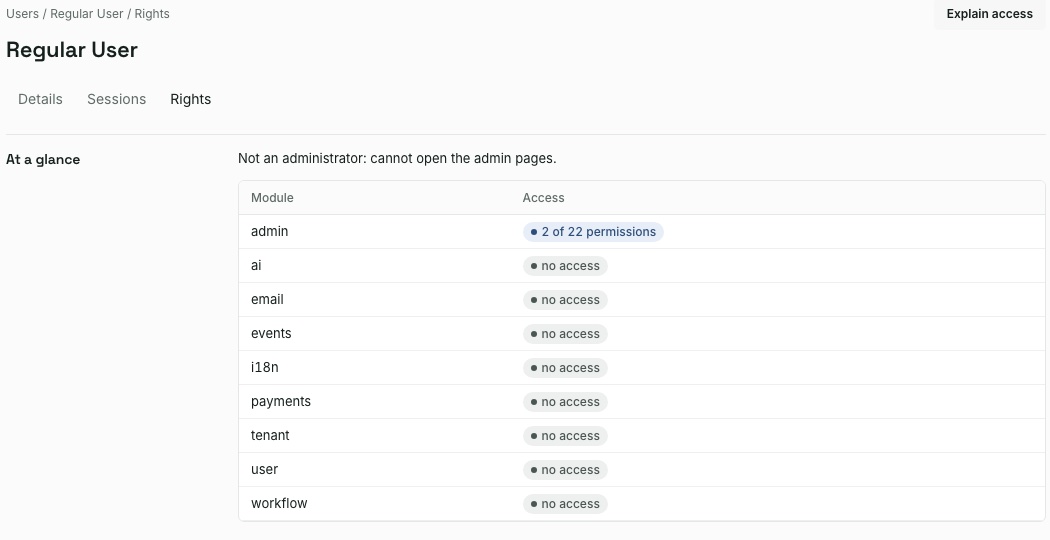
From the same tab you can view the app as that user. You get their pages, menus and buttons for 30 minutes, read-only: the server refuses every change and no live connection opens. Start and stop end up in the audit trail with your name on them. You can’t view as another administrator, or as someone in a tenant you can’t use yourself.
Taking a permission away used to be a puzzle, because it can come from a group, a role on that group, or both. Take it away now lists the options, each with what else the user loses and who else it hits. The one that takes least comes first. You can also let a membership end on a set day.
And the user list filters on a permission, a group or a role. There’s one user list now: /web/admin/users redirects to /web/users.
Roles and groups per tenant
In the 1.2.0 post I wrote that roles and groups didn’t carry a tenant yet. They do now. Each tenant has its own roles and groups, and its own admins manage them. The migration moves existing groups into their members' tenants, so nobody loses access.
Same idea for email addresses: an address is unique within a tenant. The same address in two tenants is two accounts. On a tenant’s URL you sign in to that tenant; anywhere else the sign-in form asks which one you mean.
Smaller things
-
Jetty stops at 200 concurrent requests, SSE streams included.
:max-virtual-threadson:wagoe/httpand:wagoe/rpcraises that. -
A search filter value can be a set:
{:filters {:conversation-id #{c1 c2}}}. -
/healthand friends answeredHEADwith 405, so an uptime checker that sendsHEADthought your app was down. Not anymore. -
A job enqueued inside a transaction could run before the commit and miss its rows. Jobs wait for the commit now.
-
Dependencies are up to date: Clojure 1.12.7, reitit 0.11, malli 0.20.3, next.jdbc 1.4, Jetty 12.1.15 and more.
Upgrade
curl -fsSL https://get.wagoe.org | bashOr download the installer from the release and check it first:
gh attestation verify install.sh --repo wagoebv/wagoeThen pin 1.3.0 for every com.wagoe/* dependency (all 34 artifacts are on 1.3.0) and run wagoe doctor.
These two can stop your app from booting or your monitoring from working:
-
/metrics is gone from the app port, where anyone could read it.
:prometheusserves it on its own:port, bound to127.0.0.1unless you set:host. Set:portto keep scraping. -
An unknown observability
:providerrefuses to boot outside dev, test and local. Set a real one on:wagoe/logging,:metrics,:tracingand:error-reporting, or none. If you copied the reference app’s prod config, it ran the no-op logger: set:provider :slf4j.
What else to expect:
-
API clients sign in again: old JWTs are refused. Sessions older than 7 days end at the upgrade.
-
An example
CSRF_SECRET, webhook key or OIDC:state-secretis refused outside dev.openssl rand -base64 32makes a real one. -
Add
:platform-fields #{:status :settings}and:permissions {:delete :platform-admin}to yourtenants.edn, and:list-url "/web/users"to youradmin/users.edn. -
Storage takes its limits from
:upload-limitson:wagoe/storage, or 10 MB. -
The admin service refuses keys that aren’t fields of the entity. Pass kebab-case field names.
-
A module scaffolded with
--workflowneeds two one-line changes, and a user repository of your own implementsITotpStepsandIJwtSessions. -
Re-copy your compose override, then
docker compose up -d.
All the details are in the CHANGELOG and UPGRADING.md. Stuck on an upgrade? Find me on the Clojurians Slack.